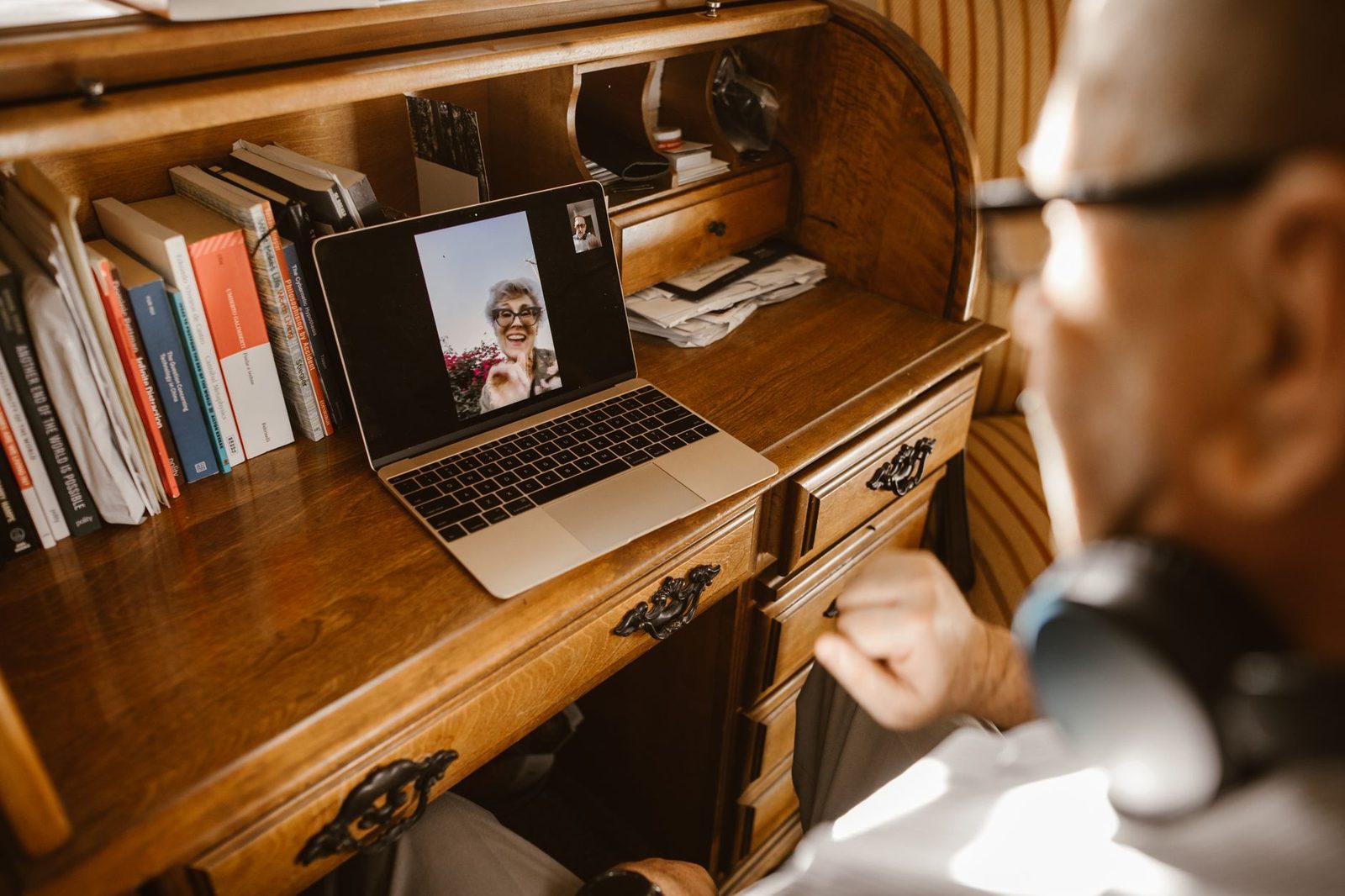
You've had seven years of English at school, a vocabulary app you've opened every morning for eight months, and still that same feeling whenever a foreign colleague speaks to you: your brain translates, your mouth waits. What you're missing isn't vocabulary. It's speaking time with someone who doesn't know you.
We've already explained here how to hold a conversation despite the language barrier — improvising, gestures, translation tools. This guide takes the problem from the other end: what if the barrier were precisely the point? Chatroulette platforms offer a rare and free resource: low-stakes conversation with a stranger. The trick is to stop skipping at random and give yourself a method.

Why a stranger sometimes beats a teacher
Let's be honest about what chatroulette does well and what it does badly. It replaces neither a structured course, nor a grammar book, nor a teacher who corrects you. What it brings lies elsewhere — and it's no small thing.
It removes the social stakes. You'll never see the person on the other side again. A clumsy sentence, a word you hunt for four seconds, a butchered conjugation: no consequences. The work of American linguist Stephen Krashen on the "affective filter" — that psychological barrier (stress, fear of looking foolish) which blocks acquisition even when the knowledge is there — describes exactly what an adult French speaker experiences in front of a native English speaker. Total anonymity is a pedagogical anxiolytic.
It forces real time. No revision app reproduces the constraint of having to answer now, without rewriting, without deleting. That's the skill you're missing after years of written work — fluency, not accuracy.
It exposes you to non-standard accents. School textbooks got you used to studio English, articulated and slow. On a chatroulette, you run into a Scot, an Indian, a Brazilian who speaks English with Portuguese vowels. The Common European Framework of Reference for Languages (CEFR), published by the Council of Europe, places precisely this ability to understand a variety of accents and registers at the heart of the B2 and C1 levels. You only acquire it through exposure.
What it doesn't do, on the other hand: nobody will correct you. Your conversation partner will understand, nod and carry on. Without a self-correction system (we'll get to that), you risk fossilising your mistakes — repeating them until they become your norm.
Setting the frame before you connect
A language training session doesn't look like a session of aimless browsing. Three decisions to make before you even open the site.
1. Choose one target language, and only one
Alternating between English and Spanish within the same half hour won't advance either. The brain takes several minutes to switch into a language; every change resets the counter. One session = one language.
2. Use the filters, but don't expect miracles
Most random video chat platforms offer a country or declared language filter. They're imperfect — a country filter can serve up a tourist or an expat — but they considerably increase your rate of useful encounters. In practice:
| Goal | Filter to favour | Common pitfall |
|---|---|---|
| Native English | United Kingdom, Ireland, Canada, Australia | The United States is saturated during off-peak European hours |
| "International" English | Netherlands, Scandinavia, Germany | Excellent level but non-native accent |
| Spanish | Mexico, Colombia, Argentina, Spain | Significant time difference with Latin America |
| German | Germany, Austria, Switzerland | Reflex switch to English the moment they hear you hesitate |
That last point is worth pausing on: in countries where English is widely mastered, your partner will spontaneously switch to English to "help" you. Say so from the outset: "Ich lerne Deutsch, können wir auf Deutsch bleiben?". Most are happy to play along.
3. Set a duration and a goal for the session
Thirty minutes is enough, and beats an hour and a half of fatigue. As we detailed in our article on the mental fatigue of marathon sessions, attention drops off quickly on video. Set a single, measurable goal: "today I'll use the structure I'd rather five times", or "I'll hold three conversations lasting more than two minutes".
Equipment: the bare minimum that changes everything
Listening comfort isn't a luxury when you're learning. Understanding an unfamiliar accent through a crackling laptop speaker means piling one difficulty on top of another.
- A closed-back headset with a microphone remains the most profitable investment: it isolates phonemes, eliminates echo and avoids the feedback that makes your partner hang up. Wired models also avoid Bluetooth latency, disastrous for lip sync — and you read lips a lot when you don't understand everything.
- A USB lavalier mic or a small desktop microphone mainly improves your intelligibility. Someone who understands you first time stays longer.
- A pocket-sized notebook placed next to the keyboard, rather than an open file: there's no time to switch windows during an exchange, but there's always time to scribble three words.
If your room echoes, add a few foam acoustic panels behind the screen: they cost a handful of euros and cut the reverberation that blurs consonants. And keep a ring light for video calls shining on your face: your partner will be reading your lips too, and the exchange will flow better.
The three-pass method
Here's the session structure that gives the best results, tested by many self-directed learners and consistent with what university language tandems recommend (the eTandem scheme, trialled since the 1990s by several European universities, rests on the same alternation).
Pass 1 — the warm-up (10 minutes)
Goal: reactivate the language, not perform. Deliberately string together short exchanges, accepting that they'll be cut short. You'll repeat the same opening lines five or six times — where you're from, what you do, why you're here. Repetitive? That's exactly the point: these formulas need to become automatic so your attention is free for what comes next.
One sentence to prepare and reuse as is:
"Hi! I'm French and I'm using this to practise my English. Would you mind chatting for a few minutes?"
Announcing your intention changes everything. People are statistically more willing to stay when you give them a role — here, that of helping.
Pass 2 — the long conversation (15 minutes)
Stop chasing volume: look for one conversation that lasts. As soon as someone engages, invest. Ask open questions, follow up, show curiosity about their country, their job, their city. The mechanism is simple: the more the person talks, the more authentic language you hear; the more you follow up, the more you produce.
Three follow-ups that work in any language:
- "What's it actually like where you live?"
- "What surprised you when you arrived there?"
- "And you, what do you think about it?"
Pass 3 — the debrief (5 minutes, offline)
This is the step everyone skips, and it's the one that makes the difference. Close the tab. Write down, while it's fresh:
- The three words you were missing. The ones you worked around with a paraphrase. Look them up now, not tomorrow.
- One structure you heard and stole. A turn of phrase your partner used that you wouldn't have produced. That's your loot for the session.
- One mistake spotted after the fact. Often you hear it as you say it. Write down the corrected version.
A spaced-repetition vocabulary notebook, or simply a squared notebook divided into columns, is more than enough. What matters is that these three items are reviewed before the next session, not stacked up.
What doesn't work (and costs you months)
Mentally translating every sentence. As long as you compose in French before speaking, you'll plateau. Chatroulette is precisely the place where you can practise speaking badly but directly. Accept the simple subject-verb-object sentence rather than the beautiful, impossible one.
Keeping the translation app permanently open. A machine translator helps out with one blocking word. Used continuously, it turns you into a subtitle reader and removes the retrieval effort — and it's that effort, "active retrieval", that cognitive psychology research has identified since the work of Roediger and Karpicke (2006) as the main driver of durable memorisation.
Confusing practice with entertainment. A session where you laughed for twenty-five minutes in French with another French speaker is a good evening, not training. That's fine — as long as you don't count it.
Clinging to overly kind partners. The person who speaks slowly, articulates and simplifies everything puts you at ease but stops helping you progress after a few minutes. Progress lives in reasonable discomfort.

Safety: the setting is still a chatroulette
Learning a language changes nothing about the basic rules, and announcing it even exposes you to a particular risk profile: the person who claims to be ready to "help you at length" and immediately suggests moving to a private messaging app.
- Don't migrate to WhatsApp or Telegram after the first conversation. A phone number is a strongly identifying piece of data. If a regular exchange genuinely interests you, go through a platform dedicated to language tandems, which has reporting mechanisms.
- Beware the educational pretext. "Send me a photo so I can correct the caption", "light your camera better", "let's carry on in private, we'll be more comfortable": these are documented social engineering techniques, which we detailed in our guide to scams and sextortion.
- Don't give your city or your school. "A town in south-west France" is more than enough to keep the conversation going. The CNIL regularly points out that cross-referencing two or three innocuous pieces of information — age, region, job — is often enough to identify a person.
- Keep the camera cover within reach. A simple adhesive webcam cover prevents the accident of a camera left running between two sessions.
How long before you feel a difference?
No study specifically measures the effect of chatroulettes on language acquisition — be wary of anyone promising you a figure. That said, the CEFR and training organisations agree on an order of magnitude: moving from one level to the next takes several hundred hours, an increasing share of which is oral as you climb.
What can honestly be said is this: three thirty-minute sessions a week, with a debrief, produce in two months a breakthrough that six months of vocabulary apps won't. Not because you'll know more words, but because you'll have stopped being afraid of saying them badly. That's almost always the real obstacle.
Round it out with a structured foundation — an English grammar book for adults consulted for ten minutes after each session, on the exact point that tripped you up. Chatroulette reveals the gaps; the textbook fills them in. On their own, each of them just goes round in circles.
In summary
| Stage | Duration | What to do |
|---|---|---|
| Preparation | 2 min | One language only, one country filter, one written goal |
| Warm-up | 10 min | Short exchanges, repeated opening lines |
| Conversation | 15 min | One person only, open questions, follow-ups |
| Debrief | 5 min | 3 missing words, 1 stolen structure, 1 corrected mistake |
Chatroulette isn't a school. It's a conversation room open around the clock, populated by strangers who won't judge you and whom you'll never see again. For an adult learner paralysed by the gaze of others, it may be exactly the missing tool — provided you turn up with a method, a decent headset and an open notebook.