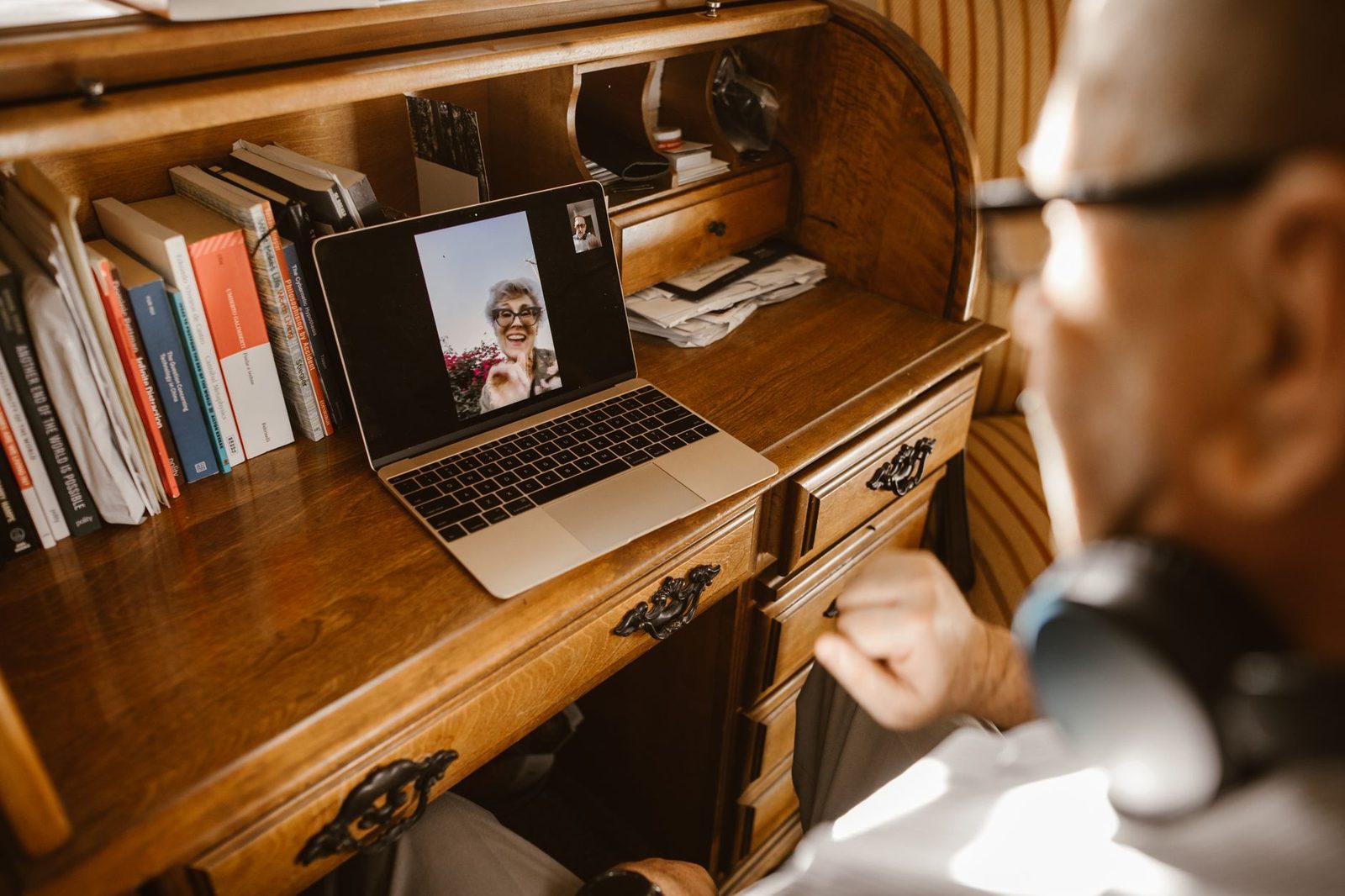
You've made it past the hard part. The other person stayed, they smiled, you swapped first names and hometowns. Then comes the fatal question: "So, what do you do for a living?" Answer. Silence. An awkward little laugh. Next. You've just lost a conversation that had everything going for it.
The problem is neither your charisma, nor your accent, nor your webcam. It's structural: on video with a stranger, two people look at each other without doing anything together. Yet a human conversation almost never survives on the exchange of information alone. It survives on a shared activity — however tiny, however absurd. Over coffee, you have the cups, the street, the waiter. On chatroulette, there's nothing. Except what you bring to it.
We've already covered the first minute of a conversation, etiquette and consent and the fatigue of marathon sessions. This article digs into an angle never isolated here: what to actually do, concretely, once the introductions are over.

Why conversations die in the third minute
There's an extremely consistent pattern in random video chat. Exchanges follow three stages:
| Stage | Typical duration | Content | Risk |
|---|---|---|---|
| 1. Screening | 0 → 10 s | A glance, the background, a smile | Instant disconnect |
| 2. Identification | 10 s → 3 min | First name, country, age, language | The questionnaire runs out |
| 3. Interaction | beyond 3 min | Game, topic, shared project | Few people get there |
Stage 2 is a trap. It creates the illusion of a conversation when it's really an oral admin form. Once the boxes are ticked, there's nothing left. And since the "next" button is a centimetre from the mouse, the cost of walking away is zero.
Getting to stage 3 means changing register: stop interrogating the other person and start doing something with them. The difference is enormous. In a question-and-answer exchange, each person waits their turn. In an activity, both are looking at the same thing — and a shared gaze is the raw material of connection.
In social psychology this is called joint attention: two individuals focusing together on a third object build a bond faster than two individuals staring at each other. It's the mechanism that explains why it's easier to talk while walking side by side than sitting face to face.
The rule of three objects: your conversation kit
The simplest way to create a third object is to have one within arm's reach. Keep three objects in your line of sight, off camera, ready to be shown.
A good conversation object meets three criteria:
- It reads in one second on screen. No tiny text, no detail that's invisible at 720p.
- It reveals nothing identifying. No mail, no diploma, no family photo, no label with your address.
- It invites a question. An object that's self-explanatory starts nothing.
A few reliable choices, tested by thousands of users:
- A musical instrument. Even three clumsy chords on a soprano ukulele are enough to make someone stay. Music crosses the language barrier better than any sentence.
- An object from somewhere else. A travel souvenir, a foreign coin, an exotic food wrapper: geographic origin instantly triggers a story.
- A pet. The retention rate of a cat walking through the frame is probably the highest on the entire internet.
- A work in progress. An unfinished drawing, a knitting project, a scale model: incompleteness creates natural curiosity.
The classic mistake is showing an expensive object. A costly item impresses for three seconds, then shuts the conversation down — sometimes by attracting the wrong kind of people. A strange or personal object works infinitely better.
The games that genuinely work on video
A chatroulette game has to work with no shared board, no account, no installation and no prior trust. That rules out 90% of ideas. Here are the ones that survive contact with reality.
"Two truths, one lie"
Each person states three claims about themselves; the other guesses which one is false. Average duration: four to six minutes. The decisive advantage: the game produces biographical content without feeling like an interrogation, and it allows for vagueness — you can lie about anything, including what's true.
Best-of-three rock-paper-scissors
Ridiculous, universal, understandable without a single word of shared vocabulary. Its real value isn't the game: it's that it synchronises two bodies through the screen. After three rounds, the mood has shifted.
Blind drawing
You describe an object out loud, the other person draws it without seeing it, then holds the result up to the camera. A simple A5 sketchbook and a black marker are all you need. It's the game that generates the most genuine laughter, because the gap between the instruction and the result is always comic.
"Show me"
A turn-by-turn challenge: "show me something blue", "show me your favourite mug", "show me the view from your window" (careful — that last one can pinpoint your location). The game gets both people standing and moving, breaking the frozen posture of a torso in front of a screen.
Geo-guessing
One person describes their surroundings without naming them — climate, street sounds, national dish — and the other guesses the country. On an international platform, this game can run for twenty minutes. It has a secondary benefit: it teaches you to talk about where you live without giving away your address.
Games to avoid
- Anything that requires downloading something or joining an external server: that's the number one vector for scam attempts.
- Any game involving forfeits or physical stakes: the slide towards requests for intimate images is fast and well documented.
- Games that require revealing personal data to score points.
Body language replaces half your words
On video, non-verbal information travels badly: narrow frame, latency, gaze offset by the camera position. So you need to overplay it slightly, without tipping into caricature.
Three simple adjustments change everything:
- Move back twenty centimetres. A frame that includes your shoulders and part of your hands makes your gestures visible. A close-up of your face erases all your body language.
- Use the off-camera space. Pulling an object in from the edge of the screen, then bringing it back, creates a small piece of staging. An articulated webcam mount arm lets you swing the camera towards your desk or your hands in a second, opening up a second "shot" for the conversation.
- Nod visibly. At 20 frames per second, a micro-nod disappears. A real, slow nod registers.
And keep the technical constraint in mind: everything you show goes through a mediocre sensor in a room that's probably under-lit. A dark object filmed against the light simply doesn't exist on screen.
Build a ritual rather than a performance
The users who last the longest — and who meet the most interesting people — aren't the most brilliant ones. They're the ones with a ritual.
A ritual is a repeatable personal routine: the same opening, the same activity offered, the same closing signal. It has three advantages:
- It removes the mental load of improvisation, the main cause of fatigue in long sessions.
- It makes your exchanges comparable: you see what works and what falls flat.
- It gives the other person a reassuring structure, just as they've landed in an anonymous environment.
An example of a simple four-step ritual:
| Step | Action | Purpose |
|---|---|---|
| 0–15 s | Greeting + one observation about a visible detail | Prove you're actually looking |
| 15 s–1 min | An open question, never "where are you from?" | Escape the questionnaire |
| 1–8 min | An activity: game, object, mini-challenge | Create joint attention |
| End | An explicit closing line | Leave cleanly, without a brutal "next" |
That last point is underrated. Cutting someone off leaves them with a sense of rejection; a simple "this was nice, have a good evening" costs three seconds and radically changes the quality of the experience — for them and for you.
The gear that makes an activity possible
No accessory will replace an idea, but some remove very real friction.
- A closed-back headset with a microphone prevents echo when you talk at the same time as the other person — essential as soon as a game involves fast turns. Boom-mic models pick up the voice far better than a microphone built into a screen.
- A small LED accent lamp placed behind the screen makes the objects you show visible. Without one, anything outside the usual frame falls into shadow.
- An articulated phone holder turns a mobile into a second, pivotable camera — handy for filming a drawing, an instrument or a recipe in progress.
- A standard deck of cards remains the most versatile tool: guessing games, draws, botched magic tricks. It costs three euros and works in every language.
Invest in this order: sound, light, framing. An inaudible activity doesn't exist; neither does a badly lit one.
Safety: the activity must never become leverage
The more enjoyable the exchange, the lower your guard. That's precisely the mechanism exploited by sextortion attempts, whose pattern the Gendarmerie nationale and the French platform Cybermalveillance.gouv.fr regularly describe: rapid trust-building, a proposal to move to another app, then a request for compromising images and blackmail.
A few safeguards to build into your ritual:
- An activity never justifies switching platforms. "Let's carry on the game on such-and-such app" is a red flag, not an invitation.
- No game requires your full name, your school, your employer or your street. If a "challenge" heads in that direction, it isn't a game.
- Showing your window, your mail, your badge or your street sign can locate you within minutes. Keep your objects neutral.
- Discomfort is information. If a suggestion makes you uneasy, the right answer is "next", immediately and without explanation.
It's also worth recalling the legal framework: in France, recording or distributing someone's image without their consent carries criminal penalties for invasion of privacy (article 226-1 of the Penal Code). That applies to you just as much as to the person on the other end.
Key takeaways
A conversation in random video chat doesn't die from lack of interest: it dies from lack of material. Two faces staring at each other exhaust their stock of questions in three minutes. Two people who play, show, draw, guess or improvise can go half an hour without effort.
Three principles are enough:
- Always have a third object within reach — an instrument, a pet, a drawing in progress.
- Offer an activity instead of a question, as soon as the introductions are over.
- Keep a ritual: same opening, same activity, same way of signing off.
The rest — lighting, framing, sound — is only there to make those three things visible and audible. The technology serves the exchange, never the other way round.