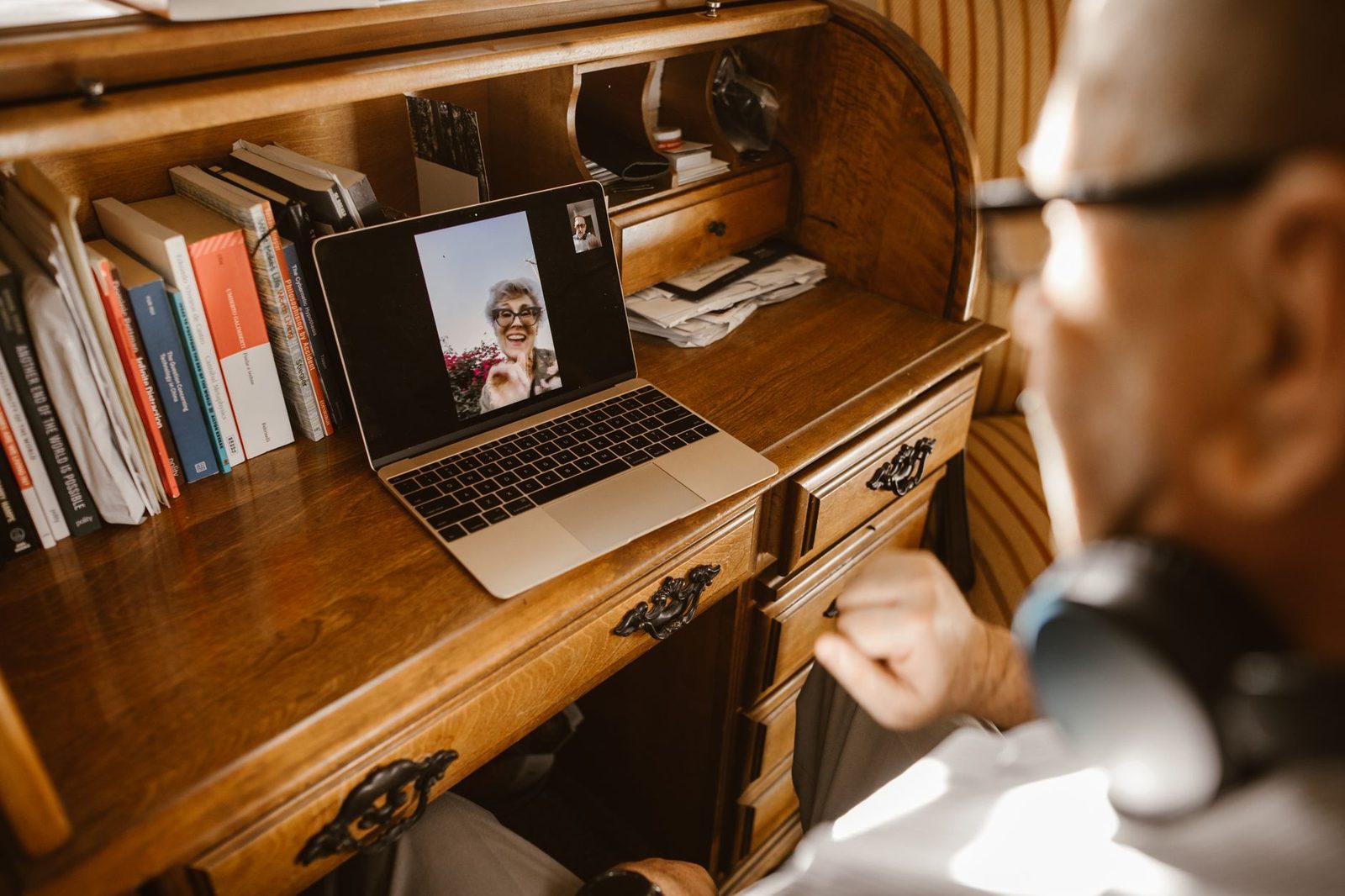
She appeared on screen, smiling, camera perfectly framed, lighting flawless. Within forty seconds, she suggested moving the conversation "somewhere else, it's quieter there." Two minutes later, you're on another platform, and the chat slides very quickly into intimate territory. You never saw it coming — and that was the whole point.
Chatroulette sites have a rare quality: they ask for no registration, no identity, no history. That's what makes them appealing, and it's exactly what attracts people who make a living from manipulation. The good news is that random video chat scams aren't creative. They follow scripts, reused thousands of times, with recognisable tics.
We've already covered moderation and reporting, privacy and the GDPR and what your background reveals about you. This article digs into an angle we've never isolated before: the scam itself — how it works, its warning signs, and what to do once the trap has closed.

Why random video chat is ideal ground for fraud
Three structural features make these platforms attractive to scammers.
Volume. A scammer doesn't need their technique to work often. They only need it to work one time in three hundred. And a chatroulette lets them run through hundreds of contacts in a single evening, with no effort, no cost, and no account to create.
Asymmetric anonymity. You're anonymous, but you're visible. They're anonymous, and often invisible — a pre-recorded video, an animated screen capture, a stream stolen from someone else. The asymmetry is total: you supply identifiable material, they supply none.
No trace. No profile, no history, no reputation. On a conventional dating app, a reported account dies. On a chatroulette, all it takes is a click on "next."
Through its Cybermalveillance.gouv.fr platform, the French Ministry of the Interior lists webcam blackmail (sextortion) among the recurring threats reported by private individuals, alongside phishing and fake tech support.
Scenario no. 1: sextortion, step by step
This is the most thoroughly documented scenario, and by far the one with the heaviest consequences. It almost always unfolds in the same sequence.
Phase 1 — The bait (0 to 60 seconds)
A female profile (in the vast majority of reported cases) appears. The image quality is abnormally good for random chat: centred framing, professional lighting, neutral background. The person smiles, says hello, and quickly sends a written message.
The crucial point: she doesn't react to what you say. If you ask a specific question — "what time is it where you are?", "can you raise your left hand?" — the answer doesn't come, or it comes after a suspicious delay, in writing.
Phase 2 — The move (1 to 5 minutes)
Very quickly, she suggests migrating: WhatsApp, Telegram, Skype, Snapchat, or a "more comfortable" site. That move serves three purposes for the scammer:
- leaving the moderated platform, where a report can cut the session short;
- obtaining a lasting identifier (phone number, username);
- gaining access, on mobile, to your contact list if you install the app they ask for.
Phase 3 — Reciprocity
She undresses first. This is a classic psychological lever: the norm of reciprocity described by social psychologist Robert Cialdini in his work on influence. What is given calls for something in return. And there's the trap: what you're watching is a video, what you're giving is real.
Phase 4 — The blackmail
A few minutes later, the tone changes. A recording of your webcam appears, often edited side by side with your clearly identifiable face. Then comes a screenshot of your public profile (Facebook, Instagram, LinkedIn — found in seconds if you gave a first name or a reused username). Then the demand: a sum of money, usually in prepaid cards or cryptocurrency, within 24 or 48 hours.

The five other scams you'll run into
| Scenario | How it shows up | The giveaway |
|---|---|---|
| The paid redirect | "Join me on this site, I'm on there more often" + link | The link leads to a sign-up requiring a bank card "for age verification" |
| The chatbot | Fluent but generic replies, automated follow-ups | It never picks up on a specific detail you've just shared |
| The romance scam | Extended contact, fast-moving affection, plans to meet | A financial emergency appears (visa, customs, hospital) — always from far away |
| The fake support / fake moderator | "Your account has been flagged, confirm your identity" | No registration-free chatroulette has an "account" to verify |
| The booby-trapped link | A file, a "photo to download," a shortened URL | Unexpected extension (.scr, .exe, .apk) or a shortener hiding the destination |
The objective warning signs, in the order they appear
You don't need to be an expert. Just watch for a few concrete things.
- The loop. A pre-recorded video repeats. Spot a gesture (a strand of hair tucked back, a sip taken, a glance off-camera) and wait: if it comes back identically every 20 or 40 seconds, it's a loop.
- The live test. Ask for an unusual, immediate gesture: three fingers raised, a hand placed on the opposite shoulder, an object held up to the camera. A real person does it in two seconds. A recording never will.
- Quality that's too perfect. A crisp, stable stream with studio lighting and clean sound, in a setting where 90% of users are filmed by a poorly lit built-in webcam, should spark curiosity — not trust.
- No sound. "My mic is broken" is the single most-used line in the repertoire. It avoids any inconsistent audio evidence.
What you hear or read
- An eagerness to leave the platform within the first two minutes.
- Untethered compliments, aimed at someone the other person knows nothing about.
- Questions steered towards identification: first name, city, employer, social media.
- Time pressure: "quick," "just once," "before I have to go."
Protecting yourself upfront: the settings that change everything
The best defence isn't constant vigilance — that runs out. It's configuration, done once, that protects you even on a tired evening.
Neutralise your background. A bare wall, or a closed door. No framed diploma, no family photos, no mail sitting on the desk, no view through a window that could identify a street. An acoustic wall panel or a simple foldable backdrop does the job nicely and improves the image too.
Cover the lens when you're not using it. An adhesive webcam cover costs a few euros and permanently settles the question of unintentional recordings outside your sessions. It's not paranoia: it's the equivalent of closing a door.
Separate your identities. Use a username that exists nowhere else. Never the one from your email address, your gaming account or your Instagram. A single search on a reused username can lead back to a full name in under a minute.
Lock down your social media. Sextortion works because the scammer can threaten to share with your contacts. Set your friends list to private on Facebook, your followers to private on Instagram. Without a visible list, the threat loses most of its force.
Never pay from the same unprotected device. If you're trying out unknown platforms, a password manager prevents credential reuse, and a security key-type USB authentication device protects your main accounts even in the event of a leak.

If the trap has closed: the six hours that matter
Panic is the scammer's fuel. The entire mechanism relies on how you react in the first few minutes. Here's the exact order of what to do.
1. Don't pay. Ever.
This is the unanimous recommendation of Cybermalveillance.gouv.fr, the gendarmerie nationale and victim support organisations. Paying doesn't end the blackmail: it confirms you can pay and triggers new demands. Accounts collected by police services describe escalations lasting several weeks after a first payment.
2. Cut off all contact
Stop replying. Don't negotiate. Don't make counter-threats. Block the account on every messaging service involved — but before blocking, complete step 3.
3. Preserve the evidence
Screenshots of the entire conversation, the username, the phone number, the Telegram/WhatsApp handle, the crypto wallet addresses or prepaid card references requested. Date them. That's what will make your complaint actionable.
4. Report it
In France, several complementary channels exist:
- 17Cyber (
17cyber.gouv.fr), the online assistance service for victims of cybercrime, launched by the Ministry of the Interior in late 2024, which points you to the right course of action after a few questions; - PHAROS, the platform for reporting illegal content (
internet-signalement.gouv.fr); - Cybermalveillance.gouv.fr, for diagnosis and referral to professionals;
- Point de contact and, for minors, 3018, the free and confidential national helpline dedicated to online violence against young people.
5. File a complaint
Blackmail is an offence under article 312-10 of the French Penal Code. Sharing sexual images without consent is also punishable (article 226-2-1). You can file a complaint at any police station or gendarmerie brigade, regardless of where you live. An online pre-complaint procedure exists to prepare the process.
6. Request content removal
If images have been shared, the major platforms have fast-track removal procedures for non-consensual intimate content. In France, Arcom and the European mechanisms introduced by the Digital Services Act (DSA), in force since 2024, require very large platforms to provide rapid reporting and processing mechanisms.
An often overlooked point: in a large share of reported sextortion cases, nothing is ever shared. Sharing earns the scammer nothing and increases their exposure. Their resource is the threat — not carrying it out.
The particular case of minors and young adults
Child protection organisations have been raising the alarm for several years about financial sextortion specifically targeting teenage boys, a phenomenon documented internationally by the National Center for Missing & Exploited Children (NCMEC) and relayed in France by 3018 and the association e-Enfance.
The essential message to pass on, if you're a parent: shame is the abuser's main weapon. A teenager who knows they can talk about it without being punished has an infinitely better chance of shutting it down within minutes. A guide to family digital mediation can help open the conversation without dramatising it, and a few simple rules — computer in a shared room, webcam physically covered when not in use — carry more weight than any parental control software.
Session hygiene in five reflexes
Worth committing to memory before you log in:
- Nothing identifying in the camera's field of view, ever.
- The gesture test as soon as a stream looks too good to be true.
- No migration to another messaging app within the first five minutes.
- No intimate content with an unverified stranger — the only content that can't be exploited is content that doesn't exist.
- No links clicked, no files opened, no apps installed on request.
These five reflexes don't eliminate risk: they do eliminate the overwhelming majority of scenarios, because scammers work on volume and immediately drop a target who resists the script.
The takeaway
Chatroulette sites aren't more dangerous than any other anonymous online space, but they concentrate one particular vulnerability: they ask you to show your face to someone under no obligation to show theirs. All the safety lies in reducing that asymmetry.
The day you're targeted, remember that you're not facing an individual with a grudge against you, but a production line processing hundreds of targets a week. Don't pay, preserve the evidence, report it to 17Cyber or PHAROS, talk to someone: in nearly every case, those four steps are enough to make the whole thing collapse.