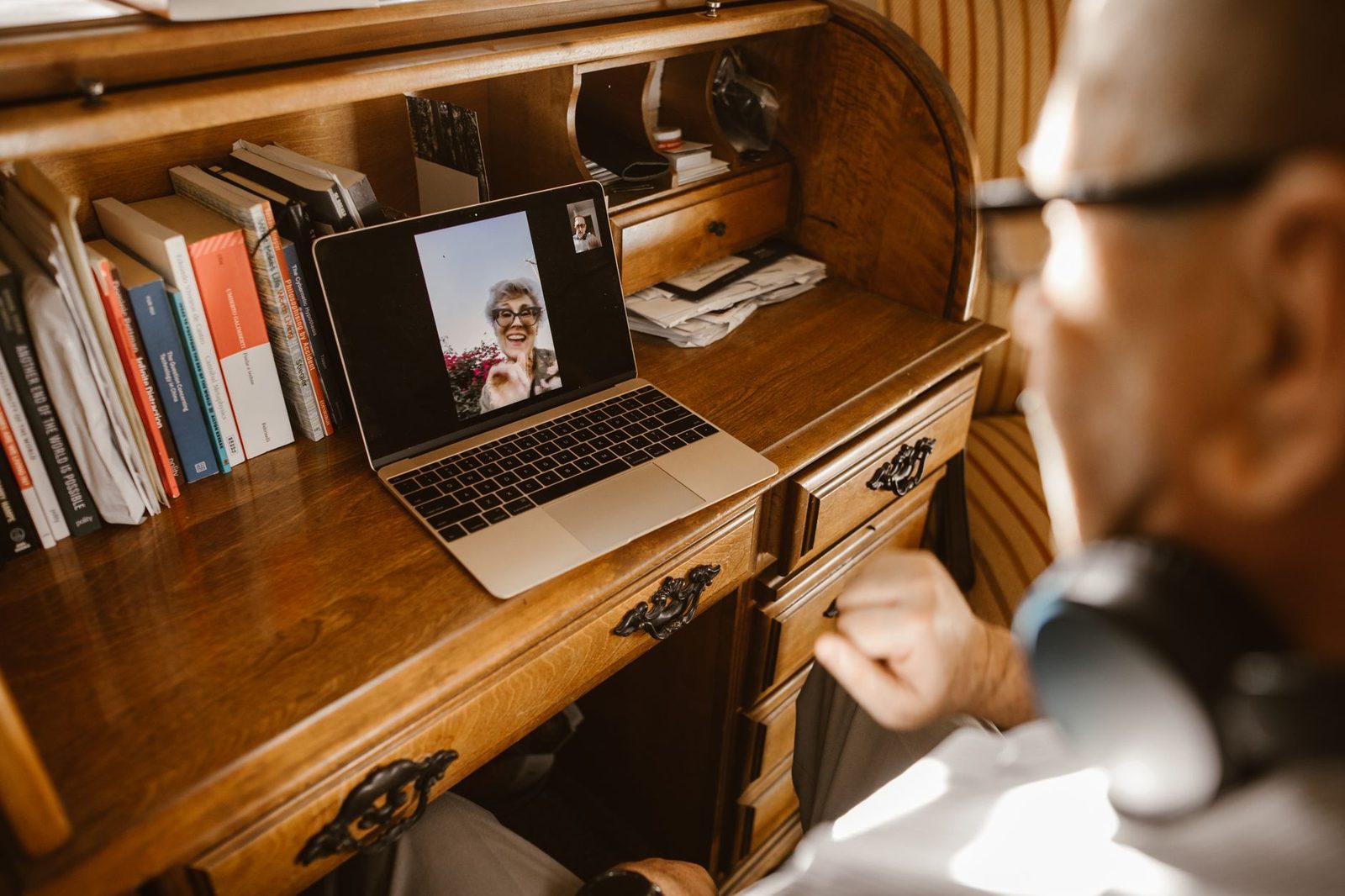
On chatroulette, the standard frame stops at the shoulders. What's left is a face, a voice, a patch of wall — and two hands that, most of the time, have vanished from view. Yet they carry half of what you think you're saying with words.
Plenty has been written here about what's visible: the background behind you, lighting and sound, the first minute of conversation. One piece is missing, and it's not a small one: the body, or rather the little that survives inside a 16:9 rectangle cropped at chest level.
Because on random video chat, everything that normally helps you look relaxed — standing posture, the way you walk, distance, turning your head — has been amputated. Very few signals remain. And a stranger who doesn't know you will read those few signals far more attentively than in real life, simply because there's nothing else to go on.

Why hands matter so much on video
Non-verbal communication isn't some coaching myth. It has been studied for decades, and hand gestures hold a special place in it: they are co-speech gestures, the ones that accompany speech and organise it.
The work of David McNeill (University of Chicago), notably in Hand and Mind (1992), established that these gestures aren't an ornament tacked onto speech after the fact: they arise at the same time as the sentence, out of the same intention. That's why we gesticulate on the phone even though nobody can see us — gesture is part of how speech is manufactured, not just how it's transmitted.
Two very concrete consequences for chatroulette:
- If you immobilise your hands, you speak less well. Hands stuck under the desk or clenched together impoverish your delivery, increase hesitation and flatten your voice. This isn't superstition: it's a documented effect of gesture inhibition on verbal fluency.
- If the other person can't see your hands, they lose information. They don't "see" what you're describing, they don't anticipate the ends of your sentences, and the rhythm of the exchange gets heavier.
Add to that an old reflex: in almost every culture, visible hands are a signal of harmlessness. Historically, showing your empty palms means showing you're holding nothing. On a platform where people fear — with good reason — inappropriate behaviour, someone whose hands are never visible sets off a quiet little alarm. Plenty of users skip without knowing why. You, now, know why.
On chatroulette, the question is never "what do I do with my hands?" but "what does the other person imagine I'm doing with my hands?"
Framing: half the problem is technical
Before we talk gestures, let's talk geometry. A laptop's default framing is almost always bad for hands.
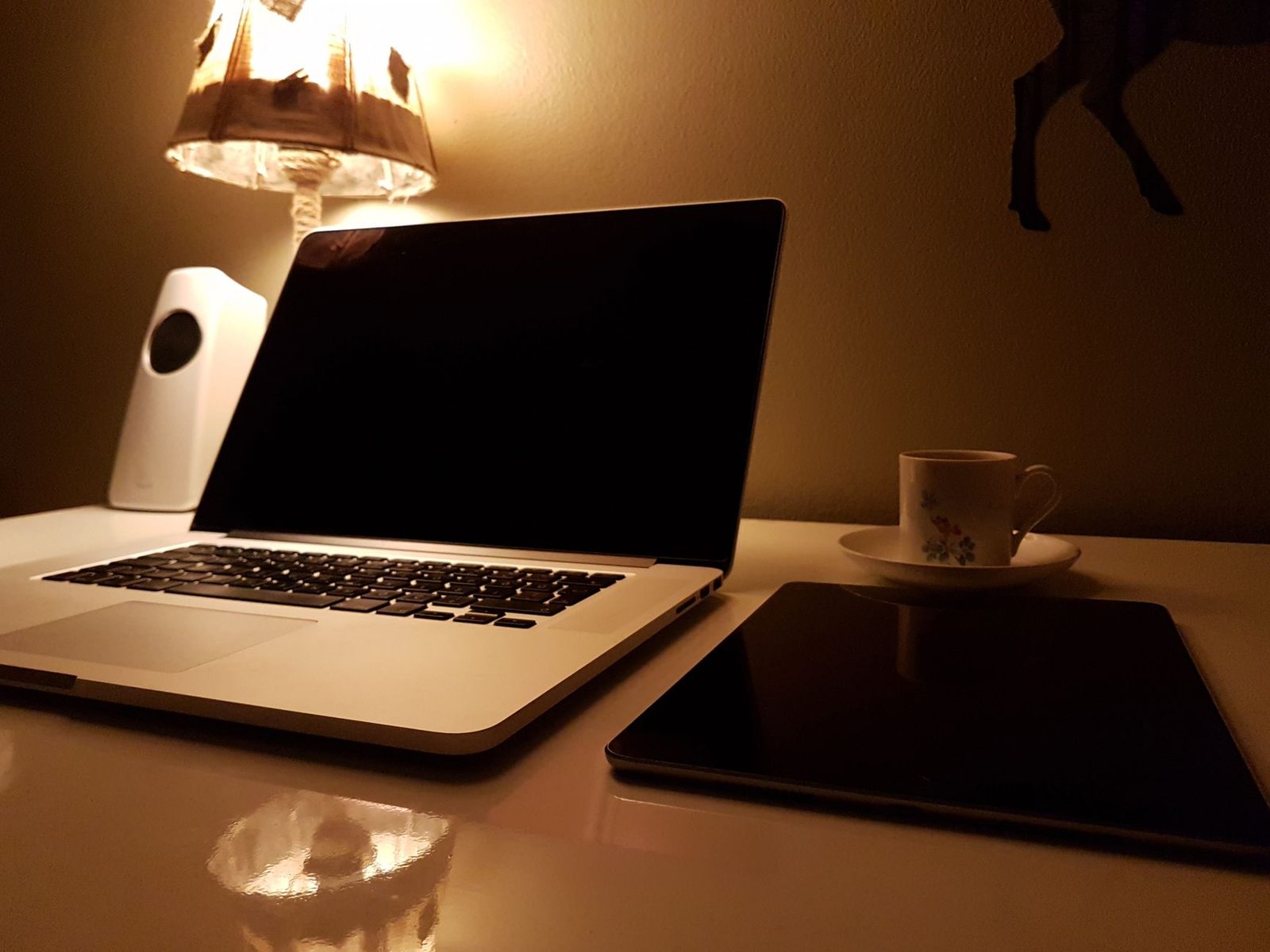
A laptop lying flat on a table puts the camera too low and too close. The result: a very tight shot of the face, from below, with the desk out of sight. Any gesture either leaves the frame or bursts abruptly into close-up in the foreground — which, on screen, looks more like a sudden movement than an explanatory gesture.
The useful framing for video dating is the wide chest shot: eyes in the upper third of the image, a little headroom, and above all the upper body down to mid-torso in frame. In that setup, a hand rising to sternum height reads perfectly without taking over the screen.
To get there:
- Move the computer back 15 to 20 cm from where you'd instinctively place it. It's the single most effective move in this whole article, and it's free.
- Raise the camera to eye level. A stack of books will do; an adjustable laptop stand does the same job without the balancing act, and frees up desk space.
- Check the bottom edge. Crop at mid-torso, never at the chin or the navel.
- Watch out for wide-angle webcams. Many built-in cameras have a wide field of view and distort anything close to the lens: a hand reaching towards the screen becomes enormous. All the more reason to keep gestures close to your body.
If your built-in camera struggles as soon as the light drops — a common problem in the evening, which is also when chatroulettes are busiest — an external 1080p webcam transforms how movement renders as much as how your face does: less motion blur when you move your hand, so gestures stay readable instead of turning into pixel mush.
Gestures that reassure, gestures that unsettle
There's no universal dictionary of gestures — the idea that a given gesture always means the same thing is a simplification that non-verbal communication researchers rejected long ago. On chatroulette, however, certain patterns produce very reproducible effects, simply because the context is loaded with suspicion.
What works in your favour:
| Gesture | Perceived effect | Why it works on video |
|---|---|---|
| Visible palms, open hands | Openness, absence of threat | The most legible signal in a small frame |
| Gestures at chest height | Natural, animated | Stays in frame without distortion |
| A hand emphasising a key word | Clarity, conviction | Helps the other person follow despite the lag |
| A brief wave at the start | Immediate warmth | Works even without the mic on |
What gets you skipped:
- Hands completely out of frame for the entire exchange, especially combined with tight framing and a dark room. That's the combo that feeds suspicion, and it's easy to avoid.
- Constant scrolling on your phone while the other person is talking. You're visibly elsewhere.
- Face propped up on your hand, elbow on the desk: read as boredom, almost every time.
- Continuous micro-fidgeting — pen, lighter, lock of hair, headphone cord. On screen, restlessness is amplified: it takes up a huge share of a tiny frame and draws the eye more than your face does.
- Hands too close to the lens, which become oversized and hide your face.
The case of objects held in the hand deserves a nuance. A mug, a notebook, a musical instrument aren't distractions: they're anchor points. A cup in your hand literally gives your hands something to do while signalling that you're relaxed. Plenty of regulars keep an insulated travel mug within reach, which also solves the problem of cold tea after twenty minutes.

Eye contact: where video calls cheat by design
You can't discuss body language on video without addressing the structural problem of eye contact.
When you look at the other person's eyes on screen, you aren't looking at the camera. So from their point of view, you're looking slightly below them. And when you stare into the camera to give them the impression of real eye contact, you can no longer see them. This contradiction is inherent to the medium: it was identified in the very earliest work on video conferencing and remains, to this day, one of the reasons a video exchange is more tiring than a face-to-face conversation — a point we explored in our piece on the fatigue of marathon sessions.
What you can do in practice:
- Move the window closer to the camera. On a large screen, drag the chat window to the top, just under the lens, and shrink it. The angle between your gaze and the camera shrinks mechanically, and the illusion of eye contact improves.
- Look at the camera for the moments that matter: your opening line, a direct question, a thank you. The rest of the time, look at the screen — that's normal, and it's exactly what we do naturally in real conversation, where we look away a good part of the time.
- Don't overdo it. A gaze locked permanently on the lens, without blinking, is genuinely unsettling.
- Watch what distracts you. A notification popping up at the top of the screen pulls your eyes away: switch to "do not disturb" before you connect.
Three minutes of setup before you connect
None of this works if you discover your own image at the same time as the stranger does. A quick solo run in front of your camera solves 80% of the problems.
The checklist:
- Open your system's camera preview and talk out loud for thirty seconds, as if someone were there.
- Look at where your hands are. If they never appear, move back or raise the camera.
- Spot your tic. Almost everyone has one: touching your nose, playing with a ring, scratching the back of your neck. You won't eliminate it, but knowing about it is often enough to calm it down.
- Check the smoothness. A gesture that leaves a trail = insufficient lighting, not a faulty camera. An LED fill light placed behind the screen, facing you, wakes the sensor up and eliminates motion blur.
- Adjust your chair height so your shoulders sit low and relaxed. A tense posture shows in the neck and trapezius muscles, even off-frame.
- Turn off the view of your own image once you've checked it, if the platform allows. Watching yourself continuously heightens self-consciousness and stiffens your gestures.
On point 6, several studies conducted during the mass shift to remote work — notably those of Jeremy Bailenson (Stanford Virtual Human Interaction Lab), who in 2021 formalised the causes of what he called "Zoom fatigue" — point to constant self-observation as a fatigue factor specific to video calls. We don't spend our days in front of a mirror; on video, we do.
The whole body, when it shows up
Sometimes you stand up, go fetch something, show the room or an object. These moments are excellent for conversation — they break the fixity of the chest shot — but they suddenly expose a lot more information.
Two reflexes:
- Anticipate what enters the frame. A mirror, an open bedroom door, a window onto an identifiable street, mail sitting on a piece of furniture. We covered this risk in detail in our guide to setting up a video-chat corner — and it counts double when you're moving around.
- Turn the camera off rather than leaving it pointing at nothing while you step away. Two minutes of filmed ceiling is the surest way to get skipped.
And if you often chat standing up or on the move, a smartphone tripod stabilises the image far better than an outstretched arm: a phone's front camera held at arm's length produces a low angle and a wobble that make every gesture unreadable at the other end.

The misunderstanding to avoid at all costs
It has to be said plainly, because it's the real context of these platforms: on chatroulette, hands out of frame carry a particular reading. Incidents of indecent exposure are frequent enough that wariness has become a reflex, and the French press has been reminded of it more than once in recent years in connection with Omegle, Chatroulette or apps like Azar.
The consequence is asymmetric and unfair, but it's there: someone whose hands and upper body are both invisible, in a dark room, will be skipped in a second by a large share of users — women in particular. That's not a moral judgement on you, it's a safety heuristic.
So you have a direct, purely practical interest in:
- staying within a frame where your shoulders and, from time to time, your hands are visible;
- lighting the room well enough that there's no ambiguity about what you're doing;
- not commenting on the other person's framing, since they have exactly the same reasons to be cautious.
And symmetrically: if it's the other person displaying these signals — blurry framing, invisible hands, insisting that you move away from the camera — don't look for excuses. Skip, and report if necessary. We've explained what happens when you report someone: it isn't a pointless gesture.
Key takeaways
Body language in video dating isn't a matter of seduction technique. It's a matter of legibility: in a tiny rectangle, with a bit of lag and zero shared context, you have to give the other person enough signals to be perceived as a person rather than one more anonymous thumbnail.
Three adjustments cover the essentials:
- Move back and raise the camera to get a chest shot your hands can enter without effort.
- Let your hands live, at chest height, palms fairly visible, without endlessly fiddling with objects.
- Light the scene, so movement stays sharp and nothing is open to interpretation.
The rest — gaze, tics, posture — sorts itself out as soon as the framing is right. As for your hands, they're only asking to speak: you just have to let them into the frame.