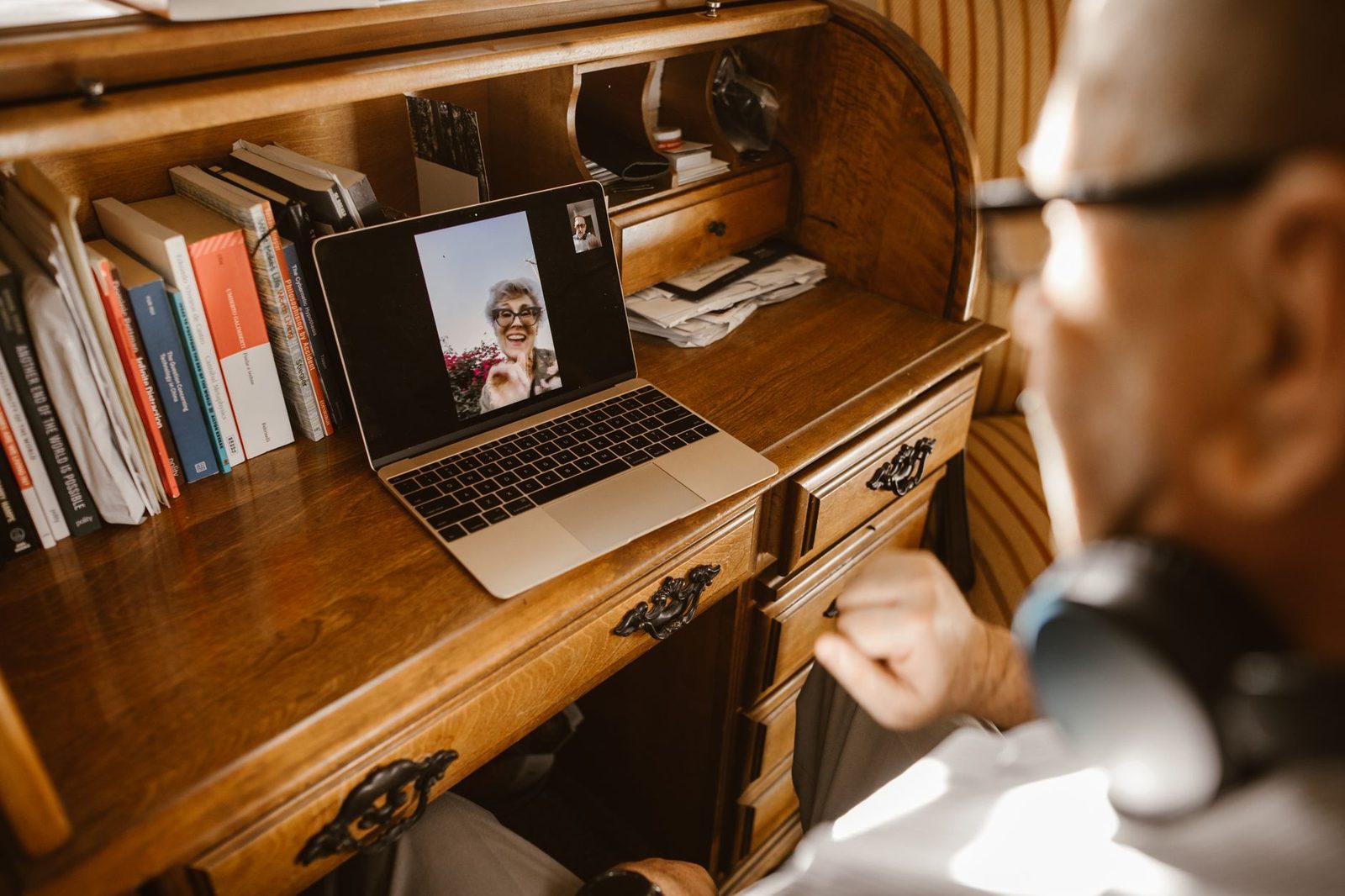
On a random video chat, almost every bad encounter follows just three scripts: the bot replaying a pre-recorded video, the fake profile pushing you towards a paid site, and blackmail based on a secret webcam recording. Each one leaves clues within the first twenty seconds. Spotting them takes far less effort than repairing the damage.
Chatroulette sites are often presented as a lottery: you supposedly stumble "by chance" upon a scammer the way you stumble upon a friendly stranger. That's false. Video-chat scams are industrialised, scripted, and rely on a very small number of mechanics repeated thousands of times a day. Someone who makes a living this way doesn't improvise: they run a script, and that script has a signature.
This guide describes those signatures one by one, in order of frequency, then explains what to do — concretely, in France — if the conversation goes wrong.

Why random video chats attract scammers
Three structural features make chatroulette sites an ideal hunting ground.
First, no sign-up required. That's these platforms' big selling point — and their weakness. With no account, no history and no reputation, a banned scammer is back thirty seconds later. Blocking measures rely on IP address or browser fingerprint, both of which any consumer VPN gets around.
Second, volume. The "next" model pairs up thousands of people per minute. A script that converts one victim in a thousand remains highly profitable when you're churning through ten thousand connections a day.
Third, instant intimacy. Video creates a sense of closeness that text never achieves. Seeing a face disarms wariness within seconds — and that's precisely the lever being pulled.
One piece of context needs adding: since Omegle shut down in November 2023, announced by founder Leif K-Brooks in a letter published on the site, users have scattered across a multitude of clones whose moderation quality varies enormously. Some have no human team behind the interface at all. The level of risk therefore depends heavily on which platform you choose, and there is no official label to sort them out.
Scenario 1: the looped-video bot
This is the most common and, thankfully, the easiest to unmask.
The principle: a pre-recorded video — often a smiling young woman in a bedroom — is streamed as though it were a live feed. A script handles the text conversation in parallel, with generic replies. The end goal is always a link: "another site where I'm better", a "free" sign-up that asks for a bank card "just to verify your age".
The tell-tale signals
- The mismatch between image and text. The person on screen never reacts to what you write. They smile, drink, look away, but their gestures bear no relation to the conversation.
- The loop. Watch for thirty seconds without saying anything: the same movements come back round. A flick of the hair, a glance to the right, a laugh — then the cycle starts again.
- The gesture test. Ask for something simple and improbable: "hold up three fingers", "write 'hello' on your hand". A bot will never do it. A real person will do it or refuse, but either way they'll respond to the request.
- Quality that's too perfect. A sharp, well-framed, studio-lit image with echo-free sound, on a platform where 90% of streams are mediocre: that's a warning sign, not a compliment. Bot videos are produced in advance, often with an LED ring light and a neutral background.
- A link within the first ten seconds. No human who's just met you sends a URL before even knowing your first name.
Simple rule: as soon as a link turns up in a conversation less than thirty seconds old, it's a script. Move on to the next person without discussion.
Scenario 2: the fake profile that moves the conversation
A more elaborate variant, with a human behind the camera this time. The aim isn't to sell you a subscription straight away, but to get you off the platform.
The sequence is standardised: a few minutes of pleasant conversation, a well-placed compliment, then "the connection's bad here, shall we move to WhatsApp/Telegram/Snapchat?". Once you're off the chatroulette site, you're no longer protected by any reporting system, and the scammer has a lasting handle with which to keep contacting you.
What follows depends on the script: a request for money for an emergency, a cryptocurrency investment proposal (the well-known "pig butchering", documented by Interpol and by many European police units), or a direct move to scenario 3.
Markers of a fake profile
| Clue | What it means |
|---|---|
| Pushing to switch apps within the first few minutes | Getting outside the moderated perimeter |
| Intense compliments, very early on | "Love bombing" technique, accelerates attachment |
| Refusal to answer a specific question about their town or daily life | Fabricated profile, poorly learned script |
| Mismatch between the stated time and the light visible on screen | A different time zone from the one claimed |
| Quick shift to money, crypto or a "great opportunity" | Financial objective |
The time-zone mismatch is particularly useful: if the person claims to be in Lyon on a Tuesday at 9 p.m. but sunlight is visibly flooding the room in broad daylight, the matter is settled.
Scenario 3: sextortion, or webcam blackmail
This is the most destructive, and it's rising sharply. The mechanics: the exchange quickly turns intimate, the other person encourages you to undress, discreetly records the sequence, then demands payment — often in cryptocurrency or by prepaid card — under threat of sending the video to your contacts. Many victims simultaneously receive a list of names harvested from their social media, which makes the threat credible.
In France, the Ministry of the Interior and the Cybermalveillance.gouv.fr platform publish quick-response guides on this type of attack, which they refer to as "chantage à la webcam" (webcam blackmail). Victim support associations and the Gendarmerie nationale regularly point out that minors and young adult men are a prime target.
The warning signs
- The other person steers the conversation very quickly towards sex, with no transition, from the first or second minute.
- They ask you to move to another app before continuing.
- Their own video shows the bot characteristics described above: it's often a loop, while you are genuinely being filmed live.
- They press for your full name, your town, your workplace, or ask you to accept a friend request.
What to do — and above all what not to do
Don't pay. This is the unanimous advice from police services: a first payment never closes the matter, it flags you as a victim who can pay and triggers a second demand.
Then, in this order:
- Stop all contact and block the account, without deleting the messages.
- Preserve the evidence: screenshots of the conversation, username, account details, crypto wallet addresses or bank details provided.
- Report the content and the account on the platform concerned, then on Pharos (internet-signalement.gouv.fr) for illegal content.
- File a complaint at a police station or gendarmerie. Blackmail is an offence under the French penal code, whatever the nature of the images.
- Lock down your social media: set your friend lists and posts to private to cut off the distribution channel.
- If you're under 18, or if you're supporting a minor: 3018, the free national helpline dedicated to online violence affecting young people, has a fast-track content removal procedure with the major platforms.
A sextortion victim has committed no offence. Shame is the blackmailer's fuel: talking to someone — a friend or relative, 3018, a police service — strips away most of their power.
Practical setup habits that shrink the attack surface
Part of the risk is handled by very basic digital hygiene, without changing how you use these sites at all.
Physically cover the lens when you're not using it. A stick-on webcam cover costing a few euros permanently settles the question of malware switching the camera on without your knowledge — a separate risk from classic sextortion, but a real one. On laptops, a thin sliding model won't stop the screen from closing.
Control what the camera sees. The background is an information goldmine: post left on a piece of furniture, a framed diploma, the view through the window, a work uniform. A removable backdrop panel or even a plain curtain behind you eliminates that leak. It's also what stops someone guessing your neighbourhood from a recognisable building.
Avoid public networks. On hotel or café Wi-Fi, a consumer VPN subscription encrypts your traffic and masks your IP address, which limits crude geolocation attempts. It's not protection against sextortion — the scammer gets their information from the conversation, not the network — but it's one less thing to hand over.
Separate your identities. Use a username that appears nowhere else, a dedicated email address, and never the profile photo you use on social media: reverse image search does the rest of the work for a motivated scammer. A password manager makes that separation manageable day to day rather than unmanageable.
Beware of files. There is no legitimate reason for a stranger met on a chatroulette site to send you an executable, an archive or a "video player to install". An up-to-date antivirus on Windows remains a basic precaution, but the best defence is still to open nothing.
How to choose a less exposed platform
Not all chatroulette sites are equal. A few observable criteria, before you even start a conversation:
- A published moderation policy, with real text detailing prohibited content, and not just an "I'm over 18" checkbox.
- A visible report button in the interface, accessible during the conversation and not hidden away in a menu.
- Separation of spaces: a section explicitly reserved for adults, distinct from the general area, indicates at the very least that the issue has been considered.
- Identifiable legal notices: a named publisher, a country of registration, a contact address. Their absence is a strong signal.
- A privacy policy that states whether sessions are recorded, and for how long.
In France, the law of 21 May 2024 on securing and regulating the digital space (known as the loi SREN) tightened age-verification obligations for sites distributing pornographic content, under Arcom's supervision. A platform hosting that kind of content without any verification mechanism is operating outside the legal framework: that's not an abstract legal detail, it's a good indicator of the operator's overall seriousness.
Five minutes of good habits
None of these rules takes any effort once they're in place.
- Never give your full name, your employer or your school. A first name is enough, and an approximate first name is even better.
- Don't show documents, screens or notifications within the camera's field of view.
- Refuse any request to move the conversation made in the first few minutes. If the person is real and interested, they'll agree to carry on where you are.
- Assume everything you show is potentially being recorded. No platform can technically prevent a screenshot on the other person's end.
- Skip without guilt. The "next" button isn't rude, it's the main safety tool these sites offer.
And for households with teenagers: a router or parental control software lets you block the relevant categories of sites, as a complement to — never a replacement for — a frank conversation about what really goes on behind these cameras.
Key takeaways
Random video chat scams are not a matter of fate. They follow three scripts, and those scripts are recognisable within the first few seconds: a stream that doesn't react to you, a link sent too early, pressure to switch apps, immediate sexual escalation. Faced with any of these signals, the right response is always the same — move on to the next person.
And if the trap has already closed: don't pay, keep everything, report to Pharos, file a complaint, and call 3018 if a minor is involved. These services exist, they handle this kind of case every day, and reporting quickly makes a real difference to what happens next.
Sources and resources: Cybermalveillance.gouv.fr ("chantage à la webcam" guide); Pharos platform, internet-signalement.gouv.fr; 3018, the national helpline against online violence; Arcom, age-verification obligations arising from the loi SREN of 21 May 2024; Omegle shutdown announcement by Leif K-Brooks, November 2023.