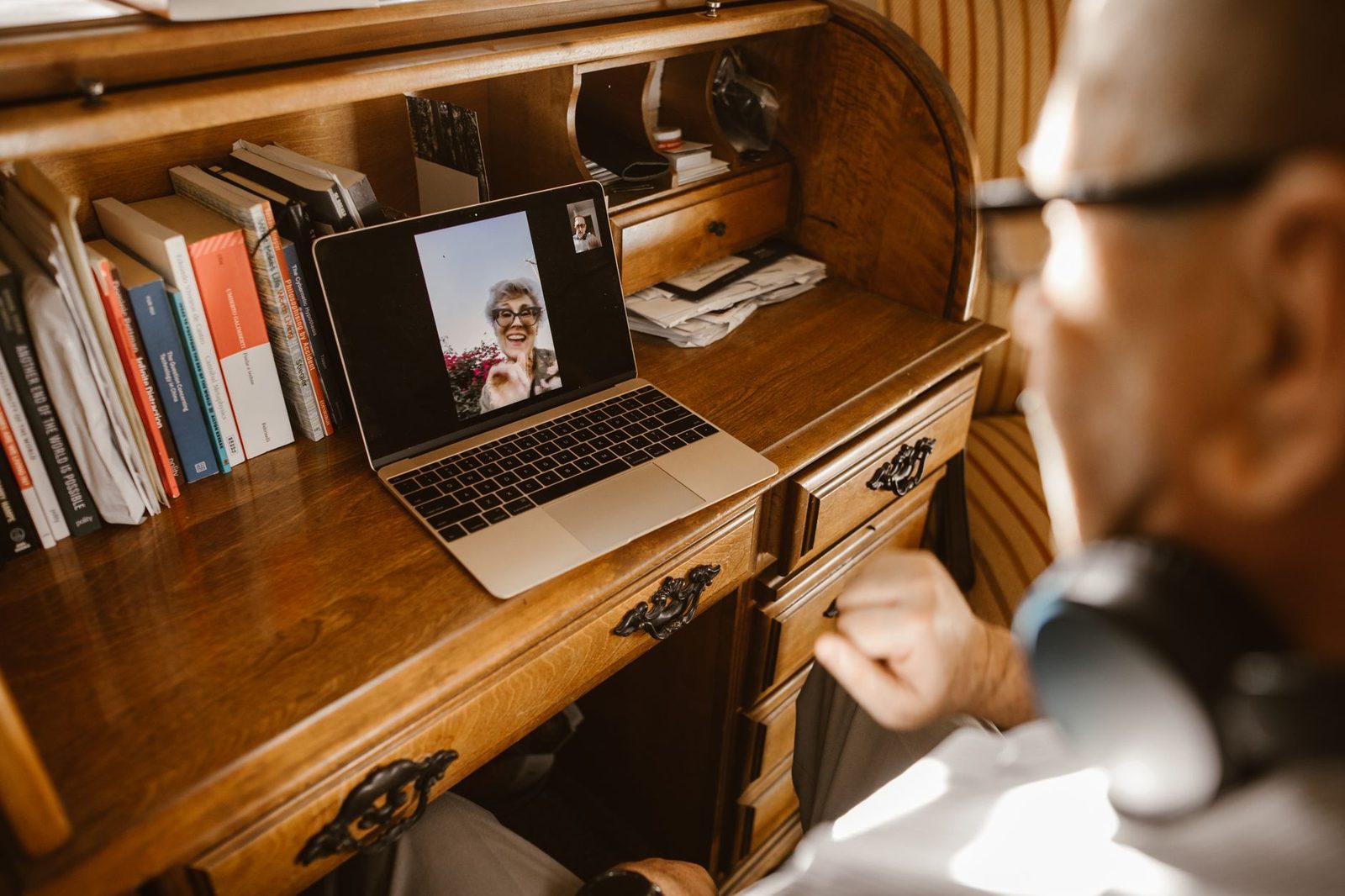
On a chatroulette, you're almost never alone with the person you're talking to. There's the series playing in another tab, the news feed on the phone sitting beside the keyboard, the game minimised in the taskbar. And the stranger across from you can see it. Immediately.
We've talked at length about what can be seen and what can be heard: the background behind you, lighting and sound, your voice, the first minute of conversation. One variable is missing, and it governs all the others: your attention. Not your goodwill, not your likeability — your ability, quite literally, to do only one thing for four minutes.
Because in random video chat, divided attention isn't a minor slip. It's the fastest-read and most badly misread signal in the entire medium. A gaze sliding towards the corner of the screen, a half-smile out of sync with what the other person just said, and the conclusion is instant: "he's bored." Next.

The multitasking myth, debunked twenty years ago
The idea that you can "follow" a conversation while watching something else is a widely held belief, and a thoroughly false one. The landmark work comes from Clifford Nass, Eyal Ophir and Anthony Wagner, published in 2009 in the Proceedings of the National Academy of Sciences (Cognitive control in media multitaskers). Their finding became famous precisely because it is counter-intuitive: people who report heavy media multitasking are not better at juggling tasks. They are worse — more susceptible to irrelevant distractions, less efficient at filtering, slower to switch from one task to another.
In other words: practising with a second screen doesn't train you to handle a second screen. It erodes your ability to ignore what doesn't matter.
The second pillar is the switch cost, documented since the 1990s by researchers such as Robert Rogers and Stephen Monsell, and later popularised by the American Psychological Association in its overviews of multitasking. Every task change imposes a mental reconfiguration delay — anywhere from a few hundred milliseconds to a few seconds. In a chatroulette session, that delay lands at exactly the worst moment: right after the other person finishes their sentence.
And that's where everything is decided. In natural conversation, the gap between two speaking turns is extraordinarily short. Work by Tanya Stivers and Nick Enfield (Max Planck Institute for Psycholinguistics, published in PNAS in 2009) measured that gap across some ten languages around the world: the median sits around 200 milliseconds, with only small cultural variation. A one-second silence already feels heavy. A two-second silence is read as disagreement, awkwardness or disinterest.
Do the maths: if your attention is coming back from a news feed, you won't reply in 200 ms. You'll reply in a second and a half, with a "sorry, what were you saying?" And you'll have burned half of your goodwill credit.
What the webcam reveals without you knowing
Face to face, we cheat rather well. We look away, we nod, the other person isn't running a slow-motion analysis. On video, three things give away divided attention with particular brutality.
The off-centre gaze
On a chatroulette, the other person occupies a window. Your eye moves to another point on the screen — a tab, a notification, your own thumbnail — and that movement is perfectly visible, because the face is framed tightly and the camera is straight on. You're not staring "into space": you're visibly looking at a specific object, off to the right or down below. The other person's brain spots it instantly; gaze detection is one of the fastest and most automatic functions of the human visual system.
The emotional lag
The laugh that arrives a second too late. The eyebrow that lifts at a joke that wasn't one. The nod during a question. These micro-desynchronisations are read as insincerity long before they're read as distraction — which is worse.
The changing light
An underrated detail: if your second screen is playing a video, the shifts in brightness reflect on your face and in your glasses. A face pulsing blue-green during a conversation tells the other person, unambiguously, that something else is going on. A steady light source — a simple LED desk lamp placed behind the screen — fixes both your complexion and that parasitic signal.
The real cost: what you don't hear
Divided attention doesn't only degrade the image you project. It deprives you of information.
A conversation with a stranger lives on details caught in passing: a regional accent, an object in the background, a hesitation over a word, a sentence slipped in between two others. Those are the details that let you bounce back, ask the question that turns a bland exchange into a real discussion. When part of your working memory is engaged elsewhere, those details aren't stored — they're not even encoded.
The result is mechanical: you ask generic questions ("where are you from?", "what do you do?"), the other person answers generically, and the conversation dies of its own flatness. You conclude that "people are boring on chatroulettes." In reality, you didn't listen long enough to give them a chance to be interesting.
On a chatroulette, you almost never lose someone because you said the wrong thing. You lose them because you said nothing at all at the right moment.
Why we fail at it: the format is part of the problem
It would be unfair to blame a lack of discipline alone. Random video chat structurally encourages divided attention, for three reasons.
Dead time is the default mode. Between two connections there's a tunnel of a few seconds while the screen looks for someone. That's an open invitation: the hand reaches for the phone. The trouble is that it doesn't have time to come back before the next person appears.
The failure rate is high. Plenty of connections don't last three seconds. The brain quickly learns that attentional investment is often wasted, and it protects itself by investing nothing from the outset. That's rational — and it's exactly what guarantees nothing will ever happen.
Anonymity disengages. With no social consequences, the politeness norm that would make you put your phone away in a café no longer applies. Nobody will ever see you again. Except that the person opposite is still applying their usual standards for reading a gaze.
Seven concrete adjustments to reclaim your attention
Nothing heroic here. These are changes to your environment, not to your willpower — and that's precisely what makes them work.
1. Go full screen, no exceptions
A full-screen chat window physically removes visual access to tabs and the taskbar. It's the highest-return measure on the whole list, and it costs one keystroke.
2. Move the phone out of arm's reach
Not "on silent": out of reach. In another room, or in a drawer. The research here is fairly clear — the mere visible presence of a smartphone is enough to reduce available cognitive resources, an effect documented by Adrian Ward and colleagues (University of Texas) in a 2017 paper titled Brain Drain: The Mere Presence of One's Own Smartphone Reduces Available Cognitive Capacity. A small desk phone stand placed behind you, screen facing the wall, does the job nicely if you want to keep it accessible without seeing it.
3. Turn off the background music
It relaxes you, it pollutes your microphone and it degrades your comprehension of a language spoken in poor audio conditions. If you want to isolate your room from outside noise, a closed-back over-ear headset is infinitely better than a playlist: it isolates you without adding a competing signal, and it eliminates the echo bounced back by your speakers.
4. Set a duration, not a goal
Twenty fully attentive minutes are worth more than two half-present hours. We've already described this mechanism in our article on the mental fatigue of marathon sessions: past a certain threshold, the quality of your presence collapses and you're just scrolling through faces. A kitchen timer sitting next to the screen — deliberately unconnected — is a more honest reminder than a phone alarm you keep snoozing.
5. Neutralise system notifications
The "do not disturb" mode on Windows, macOS or Android kills the pop-ups that, on video, trigger a sideways glance the other person reads perfectly. Five seconds of setup before the session.
6. Bring the camera closer to your line of sight
If the other person's window sits at the bottom of a large monitor and the webcam is right at the top, you never look into the lens. Moving the chat window up, just below the camera, is enough. On a desktop setup, a monitor arm lets you lower the screen to the right height, which also reduces neck strain during long sessions.
7. Occupy your hands, not your head
The need to fidget is real, and it doesn't switch off on command. A quiet, manipulable object — a soft stress ball or a simple pen — absorbs the restlessness without consuming attention, unlike a phone. We already covered this from the body-language angle in our article on what to do with your hands in front of the webcam: what holds for your image holds for your focus too.
A table to settle it
| Behaviour during a session | What you think | What the other person sees |
|---|---|---|
| Series playing on a second screen | "I'm completely ignoring it" | Light reflections, mistimed laughter, sideways glances |
| Phone lying next to the keyboard | "I barely look at it" | Head dipping down, replies taking 2 seconds |
| Music through the speakers | "It lightens the mood" | Echo, background noise, degraded comprehension |
| Tabs open behind the window | "I'm not clicking on them" | Eyes constantly scanning the screen |
| Game paused | "I'm right here" | Constant micro-lags in your replies |
Attention as a sign of respect
Let's put it plainly: on a platform where anyone can be eliminated with one click, being fully present has become a rare signal. So rare that it has a disproportionate effect.
The experiment is easy to run. Take a twenty-minute session applying the adjustments above, and note what changes. Conversations don't magically become fascinating, but two things happen: they last longer, and people ask questions back. Because they can feel they're not talking into a void.
It's also, incidentally, a safety issue. Full attention detects the signs of a scam or a sextortion attempt far earlier: the script that's too polished, the question that doesn't fit, the pressure to move to another app, the "live" image that doesn't react to what you say. These inconsistencies aren't caught out of the corner of your eye. They're caught when you're genuinely looking.
Key takeaways
- Media multitasking does not improve with practice: heavy second-screen users are worse at filtering distractions (Ophir, Nass & Wagner, PNAS, 2009).
- Natural conversation runs on a 200-millisecond gap between speaking turns (Stivers et al., PNAS, 2009) — bringing your attention back costs far more than that.
- The mere visible presence of a smartphone reduces available cognitive resources (Ward et al., 2017). You have to get it out of sight, not just silence it.
- On video, divided attention shows up on three channels: the off-centre gaze, the emotional lag, and shifting light on your face.
- The best fixes are environmental: full screen, phone out of reach, notifications off, sessions short and clearly bounded.
Random video chat never promised deep encounters. But it can't produce anything at all if nobody is really there. The difference between a frustrating session and a memorable one has nothing to do with the platform, your webcam or your wit: it comes down to how much attention you're willing to put into a rectangle a few centimetres wide, facing someone you'll never see again. That's not much to ask. It's also, these days, surprisingly hard.